
Code that works, without extra workers.
Durable execution means your code completes no matter what. LLM outages, API timeouts, server restarts, traffic spikes. Inngest makes every function durable without leaving your codebase.
The problem
Your workflows will fail.Then what?
Hand-rolled queues break under real load. With Inngest you retry from checkpoints, fan out work, control noisy tenants, wait for the real world, and see every step — without another worker fleet to babysit.
- Automatic retries
- Fan out events
- Solve noisy neighbors
- Wait without polling
- Get deep observability
Compare
What is durable execution—
and how does Inngest compare?
Durable execution keeps long-running workflows reliable with automatic retries and checkpoints when steps fail. Temporal gets you there if you can absorb the worker fleet and platform setup; traditional queues don't. Inngest delivers the same durability guarantees from the code you already run — no workers, no cluster, no separate orchestration fleet.
Primitives
Write durability directly into code.
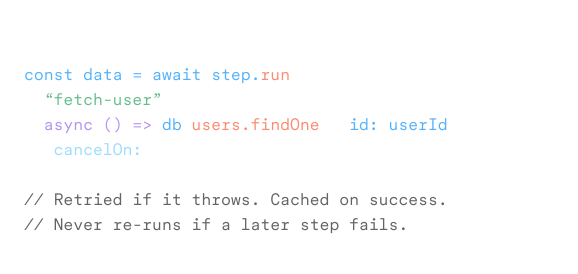
Steps—or units of work—run once, cache their result, and retry independently on failure. Write normal code, wrap functions in steps, and Inngest does the rest.
Flow control
Control flow through every event.
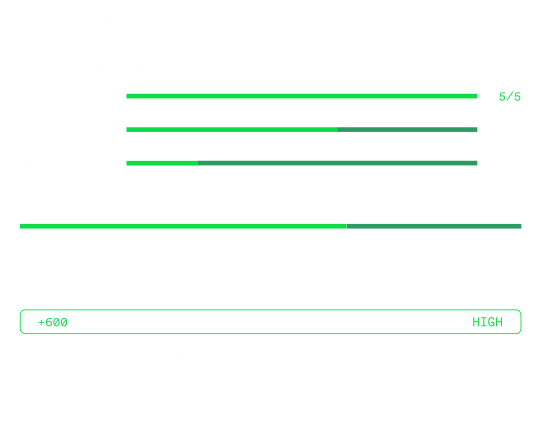
Left to a queue, work piles up, noisy tenants starve others, and APIs get hammered. Flow control is how you stay in control as volume grows.
- Concurrency — Solve noisy neighbors
- RateLimit — Control flow
- Idempotency — Collapse event bursts
- Priority — Express execution order
Observabilityby default.
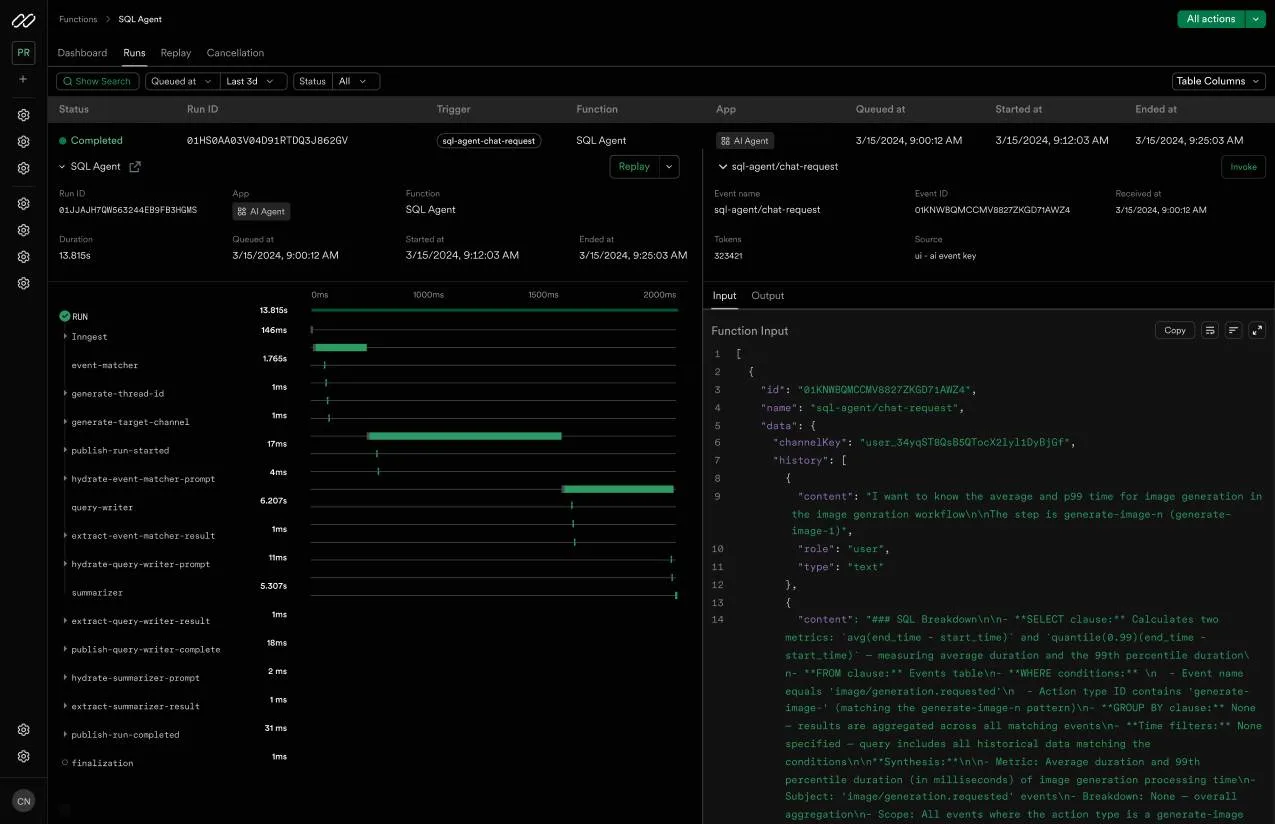
To guarantee completion, Inngest tracks the state of every step. That state is the trace — every timing, input, output, and retry, captured from day one. Score runs, group outcomes, and run experiments without bolting on another tool.
Optionality
Any code, any runtime.
Workflows, agents, endpoints. API calls, webhooks, cron. Edge, serverless, traditional. Same primitives, same guarantees, no matter what or where you run. Wrap functions in steps to make any code durable by default.
await step.run(“fetch-data”, async () => {
  return await db.query(...)
})
@inngest.create_function(...)
async def handler(ctx):
  data = await ctx.step.run(“fetch”, fetch)
step.Run(ctx, “fetch-data”, func(ctx) (any, error){
  return db.Query(...)
})
Why modern teams use Inngest for durable execution
Frictionless setup —for humans and agents.
Inngest pushes work to your code over HTTP. Deploy to whatever you're already running. Our integration with Stripe's Agent Provisioning Protocol also provides a zero-touch setup option: no key copying, no manual configuration, no billing review.
Terminal - Human Setup
$ npx inngest-cli@latest dev

✓ Agent requests access via APP
✓ Connected to your functions
✓ Traces available at localhost:8288

No cluster. No workers. No config.
Stripe APP - Agent Provisioning
Agent requests access via APPINITIATED 0mx
Credentials provisioned automaticallyGRANTED 120ms
Functions registered, ready to runLIVE 340ms

No key copying. No billing review. No manual config.
Local-first development.
One command — npx inngest-cli dev — and you have a full execution environment running locally. No mocking, no stubs, no connecting to a remote service to test your workflow. Ship with confidence because what you ran locally is what runs in prod.
Last login: Fri Apr 24 15:20:51 on ttys04
john@JohnnoMacBook-Pro ~ % cd workspace/demo-inngest
john@JohnnoMacBook-Pro demo-inngest % npx inngest-cli dev
What teams are
building on Inngest.
Real users, real use cases.
Why teams stop hand-rolling durability
Developers on retries, checkpointing, and skipping custom queue infrastructure.
 Omer DemirkanView originalDurability & retriesX
“I can't even imagine hand-rolling durability and retries. Inngest has been such a time saver. You guys are killing it.”
- Patrick DeVivoSoftware Engineer & FounderView originalBackground jobs on VercelLinkedIn
“I was skeptical of all the durable execution frameworks popping up the last couple years — but after a few weeks using Inngest, I have to admit — I'm totally sold. It's really easy to deploy frontend apps on Vercel, but there's always been this gap for background jobs. Inngest is now filling that gap for a lot of my use cases.”
 Ben PattonView originalAgent harnessesX
“If you are building a harness for non technical folks, you must understand Durable Execution. I would recommend using Inngest. Give users absolute super powers with agent led workflows.”
Stop building infrastructure around your infrastructure.
Add durability to any function in minutes. Works with your existing code, wherever it runs.